India’s space economy to reach $44 billion by 2033: EY and CII

India’s space economy is projected to grow from $8.4 billion to $44 billion by 2033, according to a joint report by EY and the Confederation of Indian Industry. The biggest share of that growth will not come from rockets and satellites, but from the services built on the data they send back.
The report, ‘From escape velocity to value: Innovate, govern and grow’, was published in September by EY and the Confederation of Indian Industry (CII). The $44 billion figure itself is not the authors’ own: it comes from IN-SPACe’s Decadal Vision of 2023, which the report takes as its reference point. What EY and CII add is an assessment of what has to happen along the value chain to get there.
The global frame is a market that was worth $613 billion in 2024 and is expected to reach $1.8 trillion by 2035. India, at $8.4 billion, accounts for around 2% of it. The report’s starting point is Space Policy 2023, the single-window regulator IN-SPACe and more than 300 Indian space start-ups – a sector that has, in its words, moved from a government-led model to an “industry participative ecosystem”.
From pilots to programmes
The largest share of value, the report argues, will sit downstream: in satellite communication, Earth observation and positioning, navigation and timing services, and in the analytics built on top of them. It counts more than 200 use cases, from crop monitoring and fleet tracking to flood warnings, insurance risk assessment and fisheries advisories.
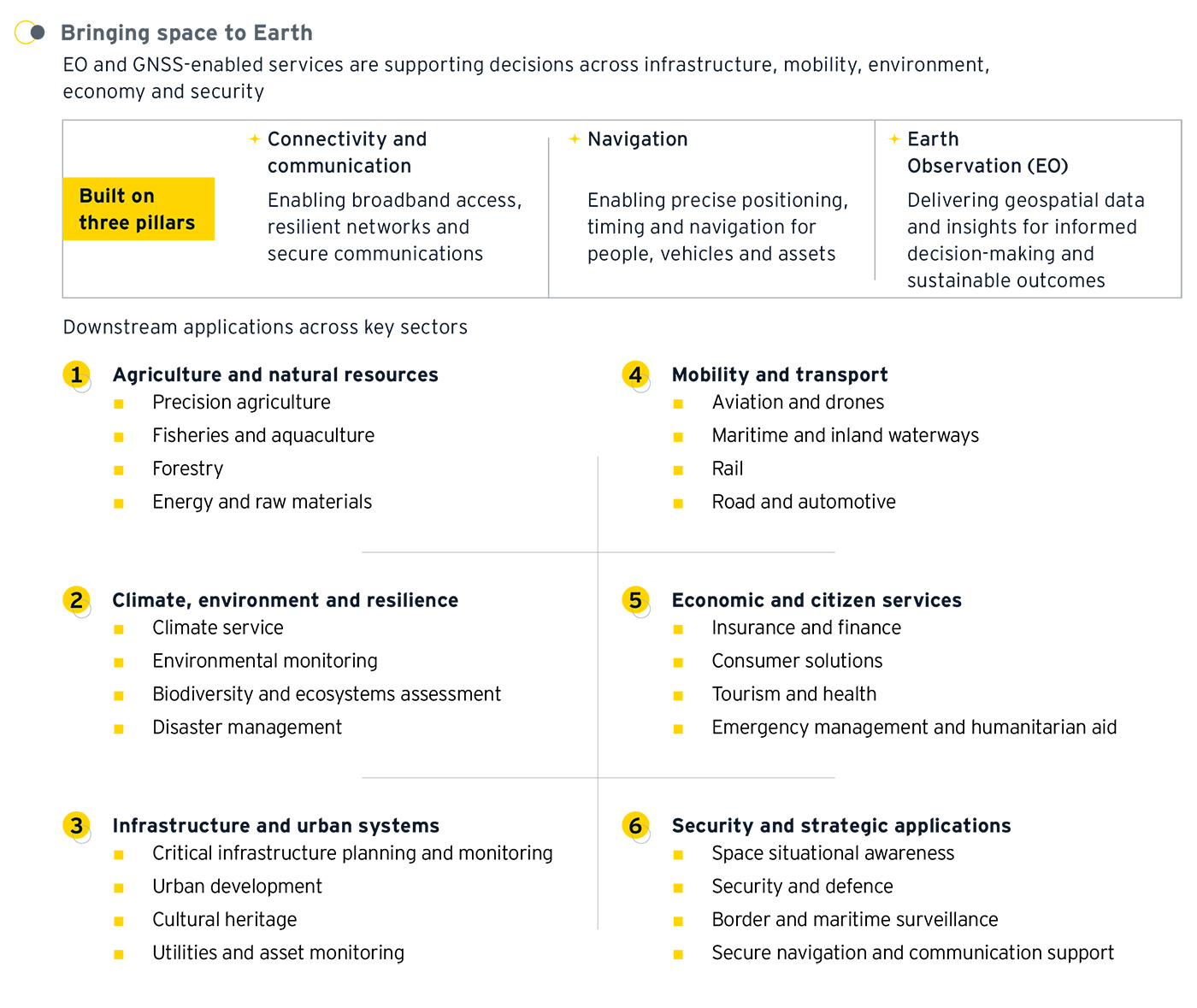
Most of these applications exist in India today as pilots. The task, according to EY and CII, is to move them to programme level – embedded in the operating systems of ministries, municipalities and infrastructure agencies – and to turn raw satellite data into what the report calls “decision-grade intelligence”. That requires interoperable data platforms, standard procurement models and a government willing to act as first customer.
“The next phase of growth will come from translating space capabilities into everyday impact through applications that improve productivity, strengthen resilience and create new business opportunities,” said Gautam Nanda, Partner, Business Consulting, Aerospace, Defence and Space at Ernst & Young LLP.
Building industrial depth
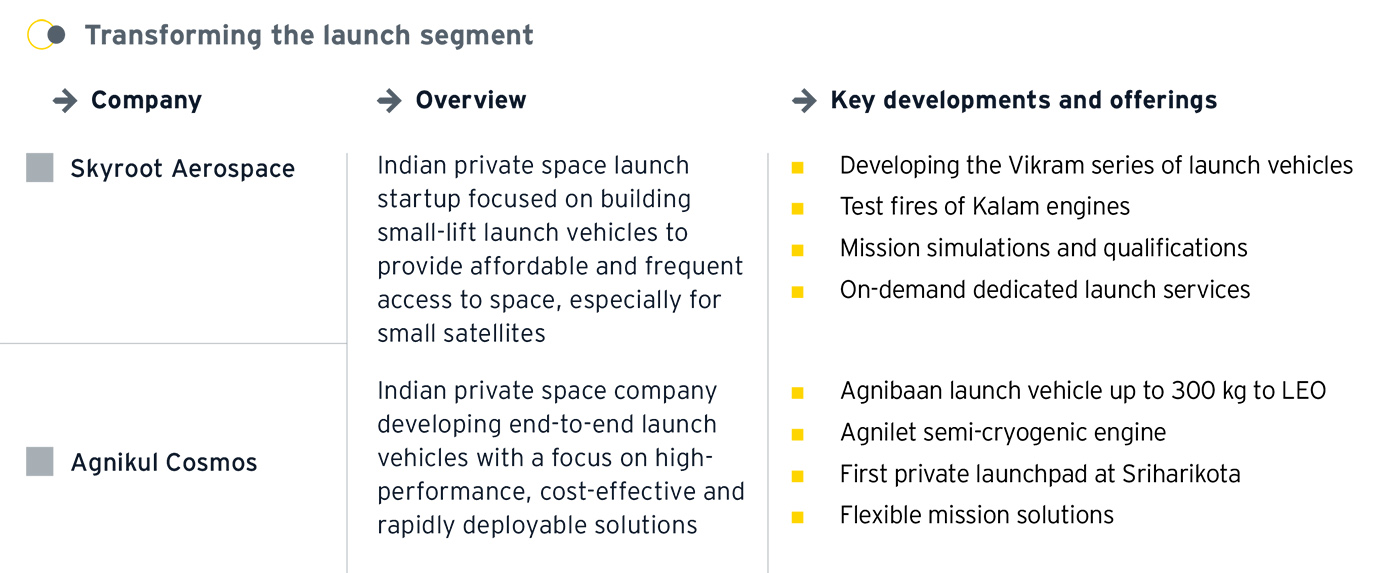
India has proved it can get off the ground. Chandrayaan-3 landed on the Moon in 2023, ISRO flew five orbital launches in 2024, and Agnikul Cosmos opened the country’s first private launchpad at Sriharikota and test-fired Agnilet, a semi-cryogenic engine that came out of a 3D printer. The question the report asks is what the country earns on the ground.
The hardware is a smaller part of the answer than its visibility suggests. Satellite manufacturing and launch services together are expected to contribute around $8.1 billion by 2033 – less than a fifth of the projected total.
Even so, the report sees an industrial opening: ISRO has handed end-to-end production of the PSLV to a HAL-L&T consortium and transferred SSLV technology to HAL, while start-ups such as Skyroot Aerospace, Agnikul and Pixxel build launch vehicles and Earth observation constellations.
Cost is the lever. The report cites industry estimates that put a partially reusable launch at around $67 million, against $110 million to $180 million for an expendable rocket. It also points to proposed Space Manufacturing Clusters and Common Technical Facilities in states including Gujarat, Tamil Nadu and Andhra Pradesh, meant to draw automotive and heavy engineering suppliers into propulsion, avionics and space-grade electronics.
Policy, capital and defence
On policy, the verdict is that the foundation is in place and the constraint is the pace of execution. The report lists streamlined authorisations, timely spectrum allocation, clear liability rules and export facilitation as the next requirements, alongside capital for deep-tech enterprises – venture funding, corporate investment, innovation grants and viability gap support.
Defence runs through the whole agenda. Governments worldwide spent around $73.5 billion on defence-related space programmes in 2025, some 54% of all government space budgets. India has its own building blocks in the Defence Space Agency, the NavIC navigation system and the GSAT-7 naval communication satellite. EY and CII want that strategic demand tied more closely to the commercial ecosystem, with private firms supplying payloads, ground systems and dual-use technology.
For CII, the shift is above all one of who does the work. “India’s space sector is entering a phase where industry participation can play an increasingly important role across manufacturing, launch systems, downstream applications and emerging technologies,” said Mallavarapu Apparao, Chairman of the CII National Committee on Space.
The report’s six priorities converge on a single positioning: India as a cost-competitive partner and export hub for Asia, Africa and the Global South, where demand for affordable connectivity, crop intelligence and disaster management is expected to grow. Between a 2% share of the global space economy today and $44 billion in 2033 lies seven years of execution – and on this reading, most of it happens on Earth rather than in orbit.